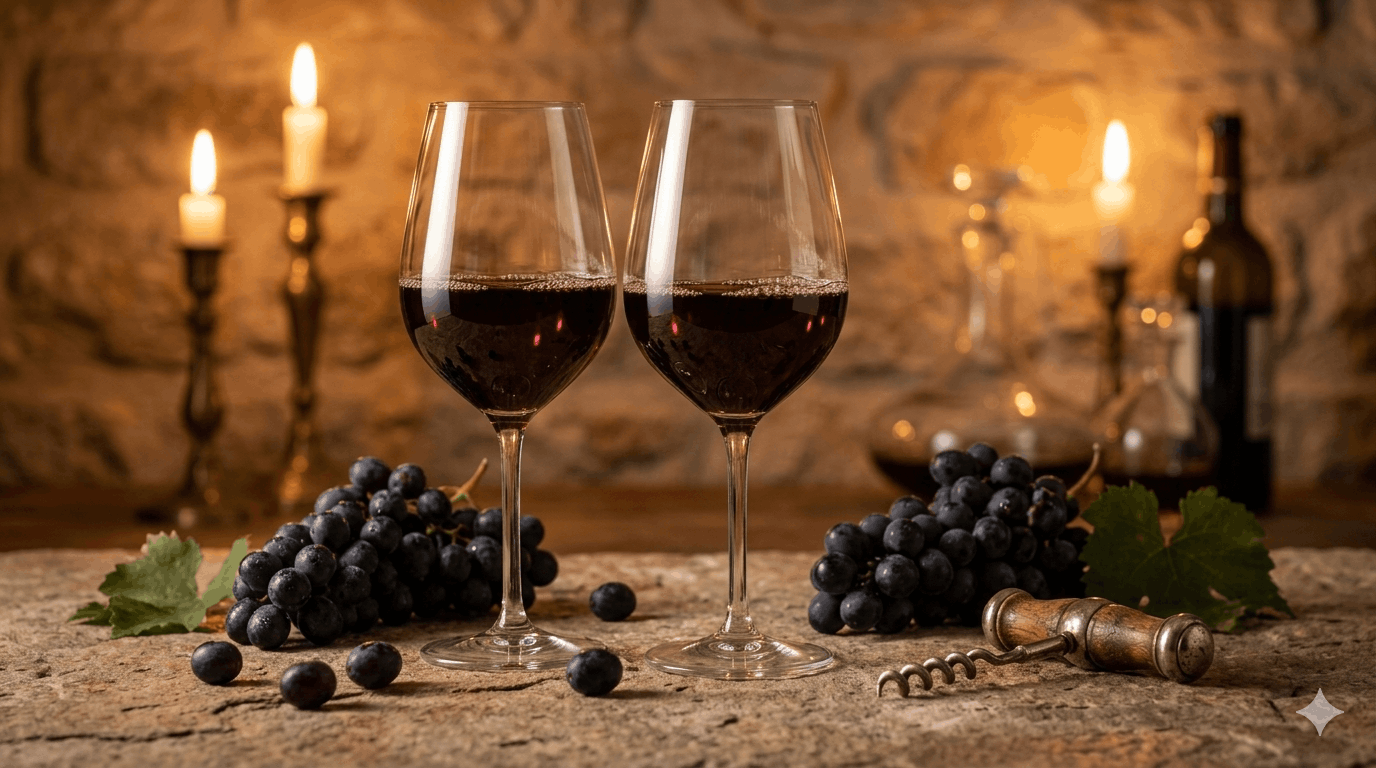
The wine world has its own hierarchies: Bordeaux, Burgundy, Rioja, Barolo, Napa Valley. But if we overlay the wine map with the EIU Democracy Index map, the result is surprising: the countries with the best democratic scores among major wine producers are not France, Italy or Spain. They are Uruguay and Chile.
This doesn't mean French or Spanish wines are poor democratic choices — they are not — but it does mean there are emerging producers with strong institutional credentials that deserve attention. And some countries with historic wine reputations present a political profile we wouldn't have expected.
The democratic ranking of major wine-producing countries
EIU 2025 — Major wine producers: Uruguay 8.91 (full democracy ✓), Chile 8.13 (full democracy ✓), Germany 8.58 (full democracy ✓), Austria 8.69 (full democracy ✓), New Zealand 9.61 (full democracy ✓), France 7.99 (flawed democracy ✓), Portugal 7.94 (flawed democracy ✓), Spain 7.94 (flawed democracy ✓), Italy 7.73 (flawed democracy ✓), South Africa 7.24 (flawed democracy ✓), Argentina 6.97 (flawed democracy, just above threshold ✓), Georgia 5.63 (hybrid regime ✗), Moldova 6.49 (flawed democracy, just above threshold ✓), China 2.12 (authoritarian ✗), Azerbaijan 2.80 (authoritarian ✗).
Uruguay: full democracy, world-class wine
Uruguay has an EIU score of 8.91, the highest in Latin America and comparable to Scandinavian countries. It is a full democracy with solid institutions, a free press and genuine political alternation. In the wine world, Uruguay has become the Latin American reference for Tannat — a grape originating in south-west France — producing structured wines with notable acidity and ageing potential.
The valleys of Canelones and Colonia are the main production areas. Wineries like Bouza, Garzón and Pisano export to Europe with growing recognition in guides such as Wine Spectator. Uruguay's case shows that democracy and wine quality are not just compatible: in this case, they coincide at the highest level.
Chile: the other democratic surprise
Chile (EIU 8.13) is also a full democracy. After the transition from Pinochet's government in 1990, Chile built one of South America's most consolidated democracies over three decades. Its judiciary, press freedom and electoral institutions have European standards.
In wine terms, the valleys of Maipo, Colchagua, Casablanca and Maipo produce globally recognised Cabernet Sauvignon, Carménère and Sauvignon Blanc. Chilean Carménère — a variety almost extinct in Europe that survived in Chile without its identity being known until 1994 — is one of the great differentiation successes of the New World.
Georgia: the cradle of wine with political shadows
Georgia has an 8,000-year wine history — it is possibly the origin of viticulture worldwide — and a growing reputation for its amphora wines (qvevri) and its indigenous varieties: Rkatsiteli, Saperavi, Mtsvane. Georgian wines are fashionable on the menus of Europe's avant-garde restaurants.
But its EIU score is 5.63, in the hybrid regime category. The 2024 elections were questioned by the EU and the US over documented irregularities. The ruling Georgian Dream party has consolidated power through legal reforms that restrict judicial independence and civil society. Several journalists and activists have been detained. This contrasts sharply with the artisanal, authentic image that surrounds Georgian wine in Europe.
At Democratic Market, Georgian wines fall below the 6.0 threshold and would not be included in the catalogue. This does not deny the quality of the product or Georgia's winemaking tradition — it is a millennia-old culture — but reflects the rules we apply consistently to all origins.
Argentina: just above the threshold, but with context
Argentina (EIU 6.97) exceeds the 6.0 threshold. Argentine democracy is real — with competitive elections and genuine alternation of power — but has documented weaknesses: judicial independence under political pressure, chronic inflation affecting institutional investment, and recurring episodes of extreme polarisation. The score of 6.97 places it at the edge of the flawed democracy category.
In wine terms, Mendoza and Salta produce globally recognised Malbec and Torrontés. Premium Argentine wine (Achaval Ferrer, Zuccardi, Catena Zapata) has earned numerous mentions in the most influential guides. Its inclusion in Democratic Market would depend on the EIU score remaining above 6.0 in the annual index.
The great Europeans: all above the threshold
France (7.99), Spain (7.94), Portugal (7.94), Italy (7.73) and Germany (8.58) are all clearly above the threshold and are functioning democracies. Their wines — Bordeaux, Rioja, Port, Barolo, Riesling — can be purchased without reservation from the democratic criterion. Austria (8.69) and New Zealand (9.61) are full democracies with growing high-quality winemaking traditions.
South Africa (EIU 7.24) is a flawed democracy with free elections since 1994, albeit with institutional weaknesses. Its wines from the Stellenbosch and Swartland regions have growing international recognition. The South African case is an example of how democratic transition can coexist with quality export industries.
China and Azerbaijan: outside the threshold
China (EIU 2.12) has invested massively in viticulture, particularly in Ningxia and Xinjiang. Some Chinese wineries have begun appearing in international competitions. However, with an EIU score of 2.12 — in the authoritarian regime category — Chinese wine does not enter our catalogue.
Azerbaijan (EIU 2.80) has a historic winemaking tradition in the Caucasus region and is attempting to relaunch its wine sector. With an authoritarian score of 2.80 — the same level as Russia — its wines also do not pass the democratic threshold.
Conclusion of the democratic wine map: if you choose wine from Uruguay, Chile, New Zealand, Austria, Germany or any Western European country, you are choosing wine from solid full or flawed democracies. If you choose Georgian, Chinese or Azerbaijani wine, the political context does not match the product's quality.