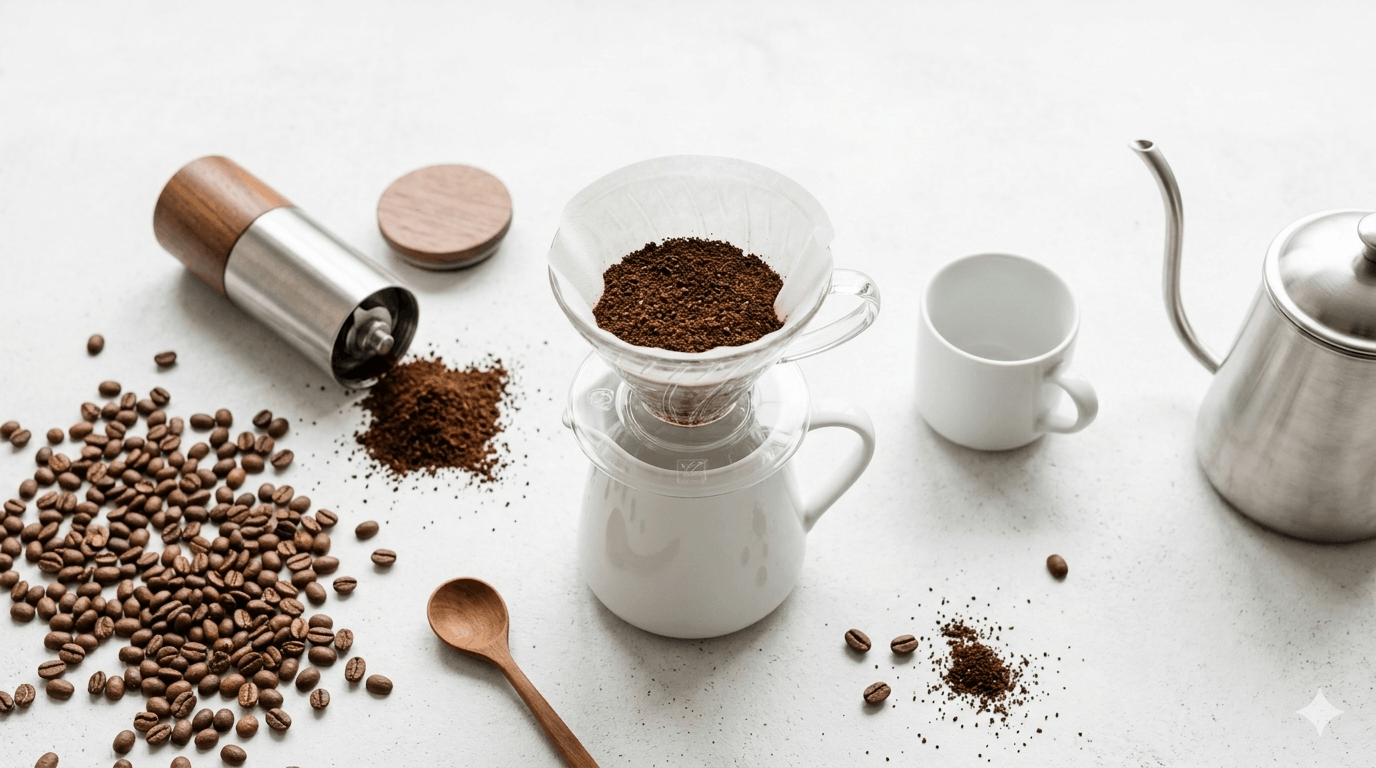
The first article we published in the Democratic Market journal was about a coffee's journey from Costa Rica to your kitchen. Today we return to the subject from a different angle: specialty coffee — the category of cup that has transformed the industry over the last decade — and its relationship with the democratic map.
Specialty coffee is not just quality in the cup. It is traceability to the individual producer, documented fair payment, specific botanical varieties and growing conditions that generate unique aromatic profiles. All of this requires origin transparency — exactly what we need to apply the democratic filter.
The Ethiopia problem: cradle of coffee, authoritarian regime
Ethiopia is, literally, the origin of coffee. The Kaffa region (in Ethiopia) gives the beverage its name. Wild varieties of Coffea arabica grow in the forests of Sidama, Yirgacheffe, Harrar and Guji. Ethiopian coffees have unique aromatic profiles — fruity, floral, citrus — that cannot be replicated in any other origin in the world. For European specialty roasters, Ethiopia is frequently the most coveted origin.
And its EIU score is 3.60. In the authoritarian regime category. Prime Minister Abiy Ahmed's Prosperity Party, which won the Nobel Peace Prize in 2019, has presided over a civil war in Tigray (2020-2022) documented by multiple human rights organisations for atrocities against civilians. The press is restricted and journalists have been detained. The 2021 elections were questioned by the EU and international observers.
EIU 2025 — Main coffee origins: Costa Rica 8.00 (full democracy ✓), Colombia 7.23 (flawed democracy ✓), Mexico 5.63 (hybrid ✗), Honduras 5.40 (hybrid ✗), Guatemala 5.22 (hybrid ✗), Kenya 5.69 (hybrid ✗), Tanzania 5.21 (hybrid ✗), Rwanda 3.31 (authoritarian ✗), Ethiopia 3.60 (authoritarian ✗), Vietnam 2.94 (authoritarian ✗), Indonesia 6.30 (flawed democracy ✓), Brazil 6.94 (flawed democracy ✓).
Democratic origins: Costa Rica and Colombia
Costa Rica (EIU 8.00) is a full democracy. It is one of the few countries in the world to have abolished its army in 1948 and has since built a democratic and environmental system that is a global reference. Its high-altitude coffees — Tarrazú, Valle Central, Tres Ríos — are recognised for their bright acidity and fruity notes. Costa Rican specialty coffee is a product where democratic origin and organoleptic quality coincide perfectly.
Colombia (EIU 7.23) is a flawed democracy but clearly above the threshold. Colombian Coffee has a Protected Designation of Origin in the EU. The valleys of Huila, Nariño, Cauca and Sierra Nevada de Santa Marta produce coffees with distinct aromatic profiles — chocolate and red fruits in Huila, floral notes and high acidity in Nariño — that make them identifiable in the cup.
Brazil: the democratic giant
Brazil (EIU 6.94) is the world's largest coffee producer — more than 35% of the global market — and a flawed democracy that exceeds the threshold. The 2022 elections, in which Lula defeated Bolsonaro, were a demonstration that Brazilian democratic institutions function under extreme pressure.
Brazilian coffee has a mixed reputation in the specialty market: large volumes of commodity coffee coexist with high-quality micro-lots from Minas Gerais and São Paulo. So-called 'Brazilian naturals' — natural processing, with chocolate and dried fruit notes — have a loyal following among coffee enthusiasts.
Indonesia: the democratic archipelago of coffee
Indonesia (EIU 6.30) is the world's fourth largest coffee producer and exceeds the 6.0 threshold. Its coffees — Sumatra Mandheling, Sulawesi Toraja, Java — have an earthy profile, low acidity and full body that completely differentiates them from Latin American origins. The Wet-Hulled method (Giling Basah), exclusive to Indonesia, generates that unique texture in the cup.
Rwanda and Kenya: exceptional quality, insufficient democracy
Kenya is one of the countries with the world's best coffees — the SL28 and SL34 varieties, the Nairobi Coffee Exchange auction system — and its EIU score is 5.69, a hybrid regime. Kenyan democracy has episodes of disputed elections with violence (2007-08, 2017) and the judiciary has been pressured on multiple occasions. It does not exceed the 6.0 threshold.
Rwanda has a surprising specialty coffee reputation — Nyungwe region, Bourbon varieties — and a remarkable recent history of economic recovery after the 1994 genocide. But its EIU score is 3.31 — authoritarian regime — and Paul Kagame's government, with more than 25 years in power, does not meet basic democratic criteria. Rwandan coffee, despite its quality, would not be included in Democratic Market's catalogue.
The tension that specialty coffee forces us to acknowledge
Specialty coffee has built its identity on traceability and direct relationships with producers. Specialty roasters travel to farms, know the farmers by name, publish the prices paid. It is the food industry with the greatest origin transparency.
But that origin transparency does not include the political context of the country. A roaster can know the name of the Yirgacheffe farmer who produces their Ethiopian coffee and not connect that fact with the Tigray war or political repression. The fair price paid to the farmer is real; the authoritarian state surrounding them is also real.
At Democratic Market we acknowledge this tension honestly. We do not pretend that excluding Ethiopian coffees is easy — it means giving up some of the world's best aromatic profiles. But consistency of criteria has a cost, and we prefer to pay it rather than making exceptions that empty the democratic threshold of meaning.
Democratic Market will include specialty coffee from origins with EIU ≥ 6.0: Costa Rica, Colombia, Brazil, Indonesia, Peru (if it exceeds 6.0 in the annual index). We require farm-level traceability, documented price paid to producer and organic or equivalent certification.