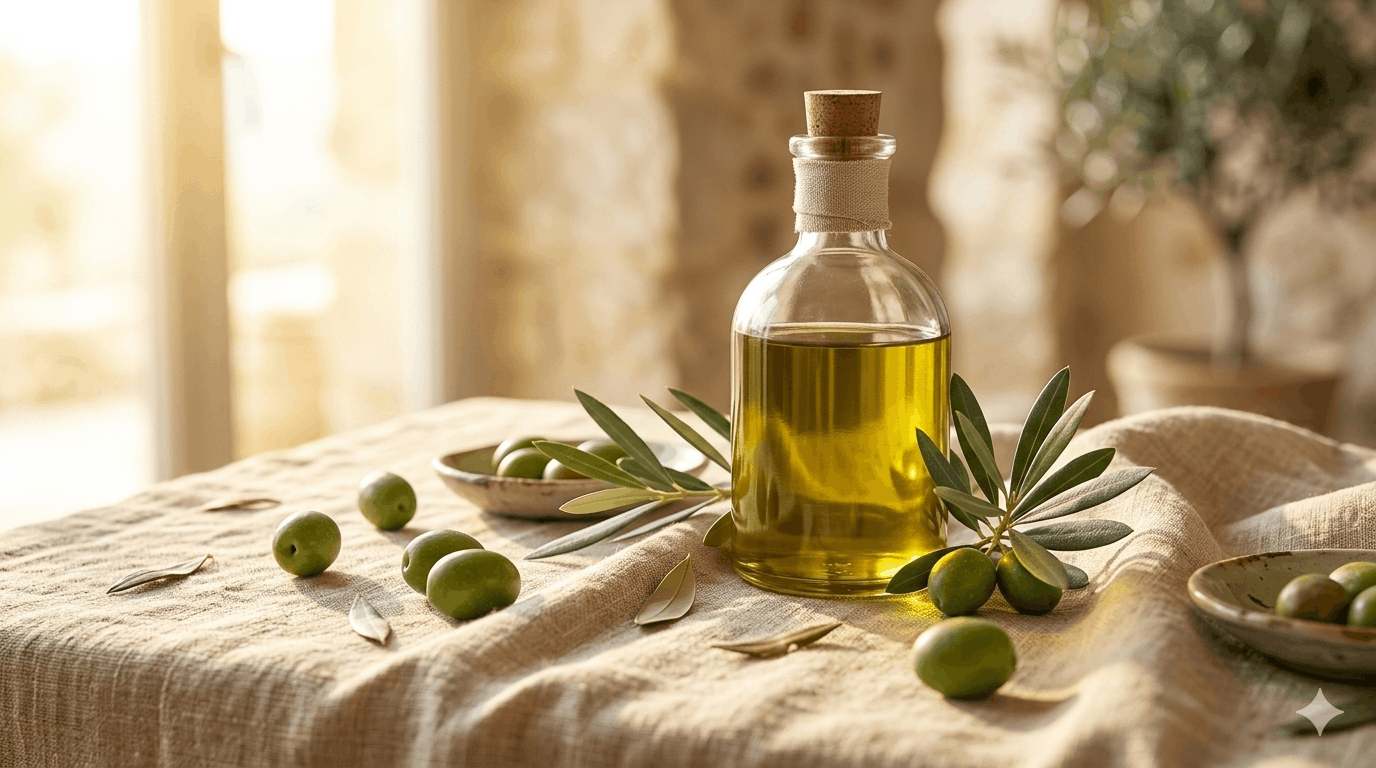
Extra virgin olive oil is, statistically, the product in your shopping basket most likely to have a democratic origin. The reason is geographic: the olive grows in a climatic belt that overlaps almost exactly with the European countries of the Mediterranean basin, all functioning democracies with EIU scores above 7.0.
But there is a catch. Over the last fifteen years, olive production has expanded significantly into Morocco, Turkey, Tunisia and Algeria, attracted by lower labour costs and favourable climatic conditions. And a portion of that oil ends up on the European market — sometimes blended with Spanish, Italian or Greek oil without a precise indication of origin.
The democratic map of olive oil
The three major world producers are Spain (47% of global output), Italy (15%) and Greece (12%). All three comfortably exceed the EIU threshold of 6.0: Spain 7.94, Italy 7.73, Greece 7.35. If your olive oil comes exclusively from one of these three countries, the democratic origin is guaranteed.
EIU 2025 — Main olive oil producers: Spain 7.94, Italy 7.73, Greece 7.35, Portugal 7.94 (all flawed democracy, above threshold). Tunisia 5.03 (hybrid, below threshold), Morocco 3.92 (authoritarian, below threshold), Turkey 4.35 (hybrid, below threshold), Algeria 3.77 (authoritarian, below threshold).
Morocco: the emerging producer that doesn't pass the threshold
Morocco has multiplied its olive oil production sixfold over the last twenty years, driven by state investment and programmes such as Plan Maroc Vert. It is now the world's fifth largest producer and the largest non-European exporter. Its oils appear increasingly in German, French and Spanish supermarkets, often without their own brands — as bulk raw material that is then bottled and labelled in the EU.
Politically, Morocco has an EIU score of 3.92, in the authoritarian regime category. Elections exist formally, but real power is concentrated in the monarchy. The press is subject to significant restrictions — journalists imprisoned for covering Rif protests, restrictions on access to official information — and civil rights show documented deficits according to Amnesty International and Human Rights Watch.
Turkey: formal democracy, diminished freedoms
Turkey is the world's fourth largest olive oil producer, with production concentrated in the Aegean (Ayvalık, Edremit) and recognised for its aromatic quality. Its EIU score is 4.35 — a hybrid regime — reflecting the institutional deterioration recorded since the 2016 coup attempt: prolonged state of emergency, purges in the judiciary, around 150 journalists imprisoned according to RSF, and severe restrictions on political opposition.
At Democratic Market, both Morocco and Turkey are below the 6.0 threshold and their oils would not appear in the catalogue. This is not a judgement on the farmers or product quality — Moroccan and Turkish olive growers can produce excellent oils — but on the institutional framework in which they operate.
The labelling problem: blends and designations of origin
European Regulation (EC 1019/2002) requires origin labelling for single-variety or designation-of-origin oils, but allows oil labelled 'EU olive oil' to be a blend of several member states without specifying which ones. More problematically, oil imported from third countries, refined in the EU, can be labelled 'bottled in Spain' or similar — which is not the same as 'produced in Spain'.
Protected Designations of Origin (PDO) solve this problem. An oil with PDO Priego de Córdoba, PDO Terra di Bari or PDO Kalamata has a traceable and verifiable origin: it can only be produced with olives from the indicated geographical area, processed in local mills and certified by the regulatory council. These designations guarantee not just organoleptic quality — they also guarantee that the oil cannot include raw material from third countries.
How to read an olive oil label
Three elements to look for on the label, in order of priority: First, Protected Designation of Origin (PDO) — if it has one, the origin is guaranteed. Second, 'produced and bottled in' + country name (not just 'bottled in'). Third, olive variety: Spanish varieties (picual, arbequina, hojiblanca), Italian (frantoio, leccino, taggiasca) or Greek (koroneiki, athinolia) do not grow significantly in Morocco.
What does not guarantee democratic origin: price (quality Moroccan oil can cost the same as a mediocre Spanish one), bottle colour, the terms 'natural', 'artisanal' or 'traditional' (unregulated), and images of olive trees or mountains on the bottle.
The best democratic oils on the European market
Spain has more than 30 olive oil designations of origin, including some of the most internationally recognised: Priego de Córdoba, Baena, Sierra de Cazorla, Les Garrigues (Catalonia), Siurana. Spanish oil alone represents almost half of global extra virgin production.
Greece, with just 12% of global production, is the country with the highest per capita consumption (20 litres/person/year) and has iconic designations such as Kalamata (Peloponnese) and Sitia (Crete). Portugal (EIU 7.94), though lower in volume, has high-quality oils under designations such as Alentejo or Trás-os-Montes, increasingly present in the European export market.
Democratic Market will index olive oils with Spanish, Italian, Greek or Portuguese PDO. The inclusion criterion is not just the EIU score of the producing country — we also require mill traceability, organic or conventional certification with audit, and documented fair payment to the farmer.
A note on pomace oil and industrial blends
Pomace oil and refined olive oil have much more opaque supply chains than extra virgin. The refining process eliminates the chemical origin indicators, making it practically impossible to verify provenance without chain-of-custody documentation. At Democratic Market we will not index pomace or refined oils, regardless of price or presentation.