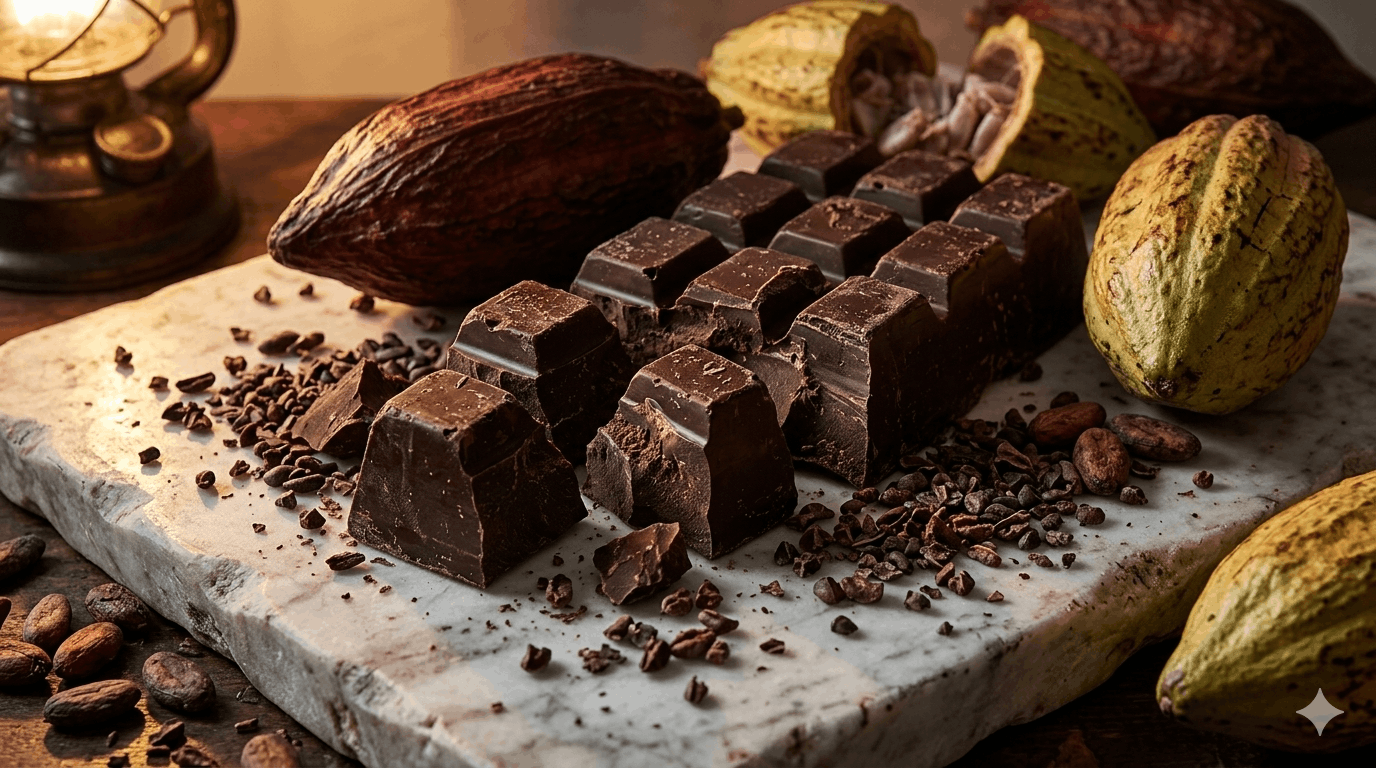
Chocolate is the democratic product we buy most without thinking. A ubiquitous ingredient — in bars, industrial pastries, beverages, cosmetics — whose supply chain has been known to researchers and NGOs for decades and unknown to most consumers.
The central fact is simple: more than 60% of the world's cocoa comes from two West African countries: Côte d'Ivoire and Ghana. Côte d'Ivoire is, according to the EIU 2025 index, an authoritarian regime with a score of 3.01 out of 10. Ghana, at 6.43, exceeds our minimum threshold of 6.0, but by a narrow margin. The result: more than half the chocolate consumed in Europe contains cocoa from a non-democratic regime.
Côte d'Ivoire: the origin that few brands name
Côte d'Ivoire produces around 45% of the world's cocoa — the world's top producer, far ahead of any other country. The cocoa economy sustains millions of rural families, but it has also been documented for decades by the use of child labour on plantations, a problem that organisations like Anti-Slavery International and the US Department of Labour continue to classify as persistent.
Politically, the country has been governed by the same party since 2011. The 2020 elections were boycotted by the opposition after a constitutional reform allowed President Ouattara to stand for a third term. Press freedom is classified as 'difficult' by Reporters Without Borders. Its EIU score of 3.01 places it in the authoritarian regime category, in the same range as Russia (2.22) or Azerbaijan (2.80).
EIU Index 2025 — Main cocoa producers: Côte d'Ivoire 3.01 (authoritarian), Ghana 6.43 (flawed democracy, above threshold), Ecuador 5.57 (hybrid regime, below threshold), Peru 5.43 (hybrid regime, below threshold), Indonesia 6.30 (flawed democracy, just above threshold).
The problem with the 'fair trade' label
The industry's standard response to the child labour and working conditions problem is the Fairtrade or Rainforest Alliance label. These certifications have real value — they improve prices paid to producers, require audits of working conditions, prohibit child labour within the certified perimeter — but they do not answer the question we ask at Democratic Market.
A product can be Fairtrade and have 100% cocoa from Côte d'Ivoire. The label certifies conditions within the audited cooperative; it does not change the political regime of the country or the institutional context in which those cooperatives operate. A Fairtrade-certified farmer in Côte d'Ivoire lives under the same authoritarian state as any other citizen of the country.
This does not invalidate fair trade. What it does invalidate is the idea that Fairtrade solves the democratic problem. They are different questions with different answers.
Ecuador and Peru: fine cocoa, insufficient score
Ecuador produces the so-called 'arriba' or Nacional cocoa, an aromatic variety of very high quality highly prized in premium chocolate. Peru, especially in the Amazon basin, has experienced notable growth in fine cocoa production over the last decade. Both countries have small but growing reputations in the European market.
The problem is political: Ecuador has an EIU score of 5.57 and Peru 5.43. Both are classified as hybrid regimes — systems where elections exist but judicial independence, press freedom and the protection of civil rights show systemic deficiencies. At Democratic Market, both are below the 6.0 threshold we require for a product's components.
Democratic alternatives: Colombia, the Dominican Republic and Ghana
Democratic cocoa exists. Three origins exceed the 6.0 threshold with significant quality production.
Colombia (EIU 7.23) has seen notable cocoa expansion over the last decade, partly as a substitute crop for coca in regions undergoing peace processes. Colombian cocoa has little presence in the mainstream European market, but appears frequently in premium bean-to-bar chocolates. The country's democratic score is solid: a flawed democracy, but with a free press, an independent judiciary, and genuine alternation of power.
The Dominican Republic (EIU 6.32) is the world's largest organic cocoa producer by volume. More than 75% of its cocoa production is organically certified, and the country exports mainly to Europe. Its EIU score places it above the threshold, and its cocoa — especially the Hispaniola variety — is recognised for its aromatic quality.
Ghana (EIU 6.43) is the world's second largest producer. Unlike Côte d'Ivoire, Ghana has a democratic system with real alternation of power and competitive elections. The difference between buying chocolate from Ghana and from Côte d'Ivoire is not small: it means supporting the only major African producer with functioning democratic institutions.
Democratic cocoa (EIU ≥ 6.0): Ghana 6.43, Dominican Republic 6.32, Colombia 7.23, Indonesia 6.30. Below-threshold cocoa: Côte d'Ivoire 3.01, Ecuador 5.57, Peru 5.43, Nigeria 4.21.
How to read a chocolate bar
Most chocolate bars do not indicate the origin of the cocoa. European labelling only requires declaring the percentage of cocoa and whether it contains milk, not the country of origin. This is an anomaly: coffee, wine and olive oil carry mandatory origin labelling; chocolate, the highest-volume cocoa product consumed, does not.
Brands that do declare origin — generally in the bean-to-bar or craft chocolate segment — do so voluntarily as part of their value proposition. Looking for this information is the first step: if the bar does not say where the cocoa comes from, assume it comes from Côte d'Ivoire (45% statistical probability) or an undeclared blend.
Five questions to evaluate a bar: Does it state the country of origin of the cocoa? Does that country have an EIU ≥ 6.0? Does it carry traceability certification or an independent audit? Is it single-origin or anonymous blend cocoa? Does the manufacturer publish its list of suppliers?
Bean-to-bar chocolate and origin transparency
The bean-to-bar movement — manufacturers who buy cocoa directly from producers and control the entire roasting, grinding and moulding process — has built over the last decade a culture of origin transparency that industrial chocolate does not have.
Manufacturers such as Zotter (Austria), Pump Street (UK), Ökoladen (Germany) or Solé Graells (Spain) publish not just the country of origin but the cooperative, the farmer, and in some cases the batch. This transparency makes it possible to apply the democratic filter: if the bar says 'cocoa from Colombia, Cacao para el Futuro cooperative, Huila, verified at plantation level', we can cross-reference that data with Colombia's EIU score (7.23) and confirm the origin exceeds the threshold.
The price of these bars is higher — between €4 and €9 for 70 grams — but the difference is not just organoleptic quality: it is real traceability versus statistical opacity.
Democratic Market will only include chocolate with 100% traceable cocoa from EIU ≥ 6.0 countries. We are currently in evaluation with bean-to-bar manufacturers from Spain, Germany and the United Kingdom using cocoa from Colombia, the Dominican Republic and Ghana.
A note on milk chocolate
Milk chocolate complicates the analysis because it introduces a second ingredient with its own supply chain. Milk generally has a local or regional European origin, with EIU scores for the producing countries (Germany 8.58, Netherlands 9.26, France 7.99) all above the threshold. The problematic component is almost always the cocoa, not the milk.
White chocolate contains no cocoa paste — only cocoa butter and sugar — and cocoa butter has the same origin problems as solid cocoa. A white chocolate with cocoa butter from Côte d'Ivoire has the same democratic profile as a dark bar from the same origin.