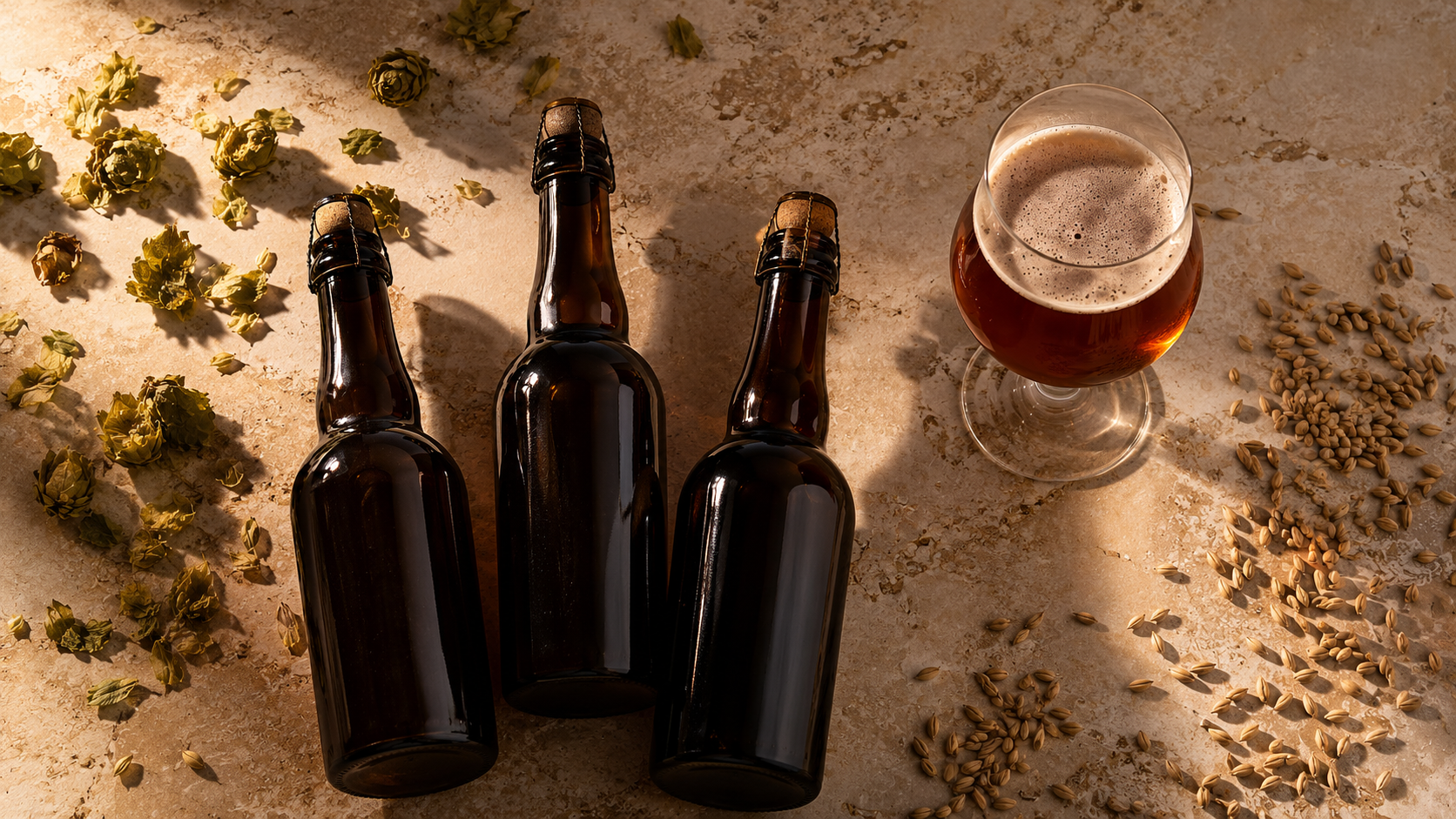
La cerveza parece un producto sencillo: agua, cebada, lúpulo, levadura. Pero detrás de cada marca hay un país de origen, una estructura de propiedad corporativa y, en muchos casos, una cadena de suministro que atraviesa fronteras con gobernanzas muy distintas. Democratic Market ha analizado el mapa democrático de la cerveza de importación más consumida en Europa — y el resultado tiene ganadores claros y perdedores evidentes.
La categoría de cerveza tiene una particularidad respecto a otros productos: la concentración corporativa extrema. Cuatro grupos controlan más del 50 % de la producción mundial: AB InBev (Bélgica/EE.UU.), Heineken (Países Bajos), Carlsberg (Dinamarca) y Asahi (Japón). Conocer la propiedad es tan importante como conocer el país donde se llena la botella.
Las Trappist: el origen democrático más sólido del mercado
Las cervezas Trappist son las únicas en el mundo con una denominación de origen monástica certificada internacionalmente (Authentic Trappist Product, ATP). Solo existen 13 cervecerías Trappist reconocidas en el mundo. Seis están en Bélgica (EIU 8,28), dos en los Países Bajos (EIU 9,00), una en Austria (EIU 8,60), una en Italia (EIU 7,73), una en Reino Unido (EIU 8,28) y dos en EE.UU. (EIU 7,85).
Chimay (abadía de Notre-Dame de Scourmont, Hainaut, Bélgica) es la Trappist más exportada del mundo. Sus cervezas — Roja (7°), Blanca (8°) y Azul (9°) — se producen íntegramente en la abadía. Westmalle (provincia de Amberes, Bélgica) inventó el estilo Tripel en 1956 y sigue elaborando en la misma abadía. Westvleteren (abadía de Saint-Sixtus, Vleteren, Bélgica) es considerada por muchos expertos la mejor cerveza del mundo — y solo se vende en la abadía o por reserva telefónica.
En los Países Bajos, La Trappe (abadía de Koningshoeven, Tilburg) es la única Trappist holandesa de escala comercial y la más accesible fuera de Bélgica. Su cuádruple (10°) es una referencia de estilo. Zundert (abadía de Maria Toevlucht, Brabante Septentrional) produce en cantidades muy limitadas. Ambas elaboran en uno de los países con mayor puntuación democrática de Europa (EIU 9,00).
EIU 2025 — Países de origen de las principales cervezas de importación: Países Bajos 9,00 ✓ (La Trappe, Grolsch, Heineken) · Irlanda 9,05 ✓ (Guinness) · Alemania 8,58 ✓ (Weihenstephan, Paulaner, Krombacher) · Austria 8,60 ✓ (Trappist Engelszell) · Bélgica 8,28 ✓ (Chimay, Westmalle, Westvleteren, Duvel, Leffe) · Rep. Checa 7,69 ✓ (Pilsner Urquell — propiedad Asahi, Japón 8,40) · Rusia 2,22 ✗ (Baltika — vendida por Carlsberg en 2023) · China 2,12 ✗ (Tsingtao, Snow Beer).
Alemania e Irlanda: democracia con raíces centenarias
Alemania (EIU 8,58) es el país con mayor tradición cervecera de Europa por volumen y diversidad de estilos. Weihenstephan (Freising, Baviera) es la cervecería más antigua del mundo en funcionamiento continuo desde el año 1040 — y sigue siendo propiedad del Estado de Baviera. Paulaner (Múnich) y Hofbräu (Múnich, cervecería estatal bávara desde 1589) son referencias mundiales del estilo lager y weizen. Krombacher (Kreuztal, Renania del Norte-Westfalia) es la marca de cerveza más vendida de Alemania, elaborada íntegramente en Alemania.
Irlanda (EIU 9,05) es el hogar de Guinness, elaborada en la histórica cervecería de St. James's Gate en Dublín desde 1759. Guinness pertenece a Diageo (Londres/Dublín, Reino Unido, EIU 8,28), pero su cerveza de referencia — la Guinness Draught y la Extra Stout — sigue elaborándose en Irlanda. El lúpulo procede principalmente del Reino Unido e Irlanda, la cebada de maltería irlandesa y británica.
El problema AB InBev: marca belga, multinacional global
Anheuser-Busch InBev (AB InBev) es la mayor empresa cervecera del mundo por volumen. Tiene sede legal en Lovaina (Bélgica, EIU 8,28) y cotiza en Bruselas, Nueva York y Ciudad de México. Sus marcas incluyen Stella Artois, Leffe, Hoegaarden, Jupiler, Budweiser, Corona y Becks, entre más de 500 otras.
El perfil democrático de AB InBev es complejo. La sede es belga y la gobernanza corporativa se rige por derecho belga y de la Unión Europea. Sin embargo, la producción de muchas de sus marcas 'europeas' se ha trasladado progresivamente a plantas en países con menor puntuación democrática. Leffe, por ejemplo, se elabora en parte en la propia Bélgica, pero también en plantas de AB InBev en otros países según el mercado de destino. La regla de Democratic Market es clara: verificamos dónde se elabora la cerveza que llega al mercado europeo, no solo dónde está registrada la marca.
Baltika y Tsingtao: el lado opuesto del mapa
Baltika (San Petersburgo, Rusia, EIU 2,22) fue durante décadas propiedad de Carlsberg (Copenhague, Dinamarca, EIU 9,15). En 2023, tras la invasión de Ucrania, Carlsberg anunció su salida de Rusia — pero el Kremlin decretó la gestión temporal de sus activos y Baltika sigue operando bajo control de facto ruso. La marca sigue disponible en algunos mercados europeos de nicho. Democratic Market no la incluye en su catálogo.
Tsingtao (Qingdao, China, EIU 2,12) es la cerveza china más exportada del mundo. AB InBev posee aproximadamente el 27 % de Tsingtao Brewery Group, lo que la convierte en accionista significativo de una empresa operando bajo la legislación china. Snow Beer (CR Beer, controlada por China Resources, empresa estatal china) es la cerveza más vendida del mundo por volumen — fundamentalmente en China, con exportación creciente. Ambas quedan por debajo del umbral democrático de 6,0.
En resumen: para cerveza de importación, el análisis democrático señala claramente a las Trappist belgas y neerlandesas (Chimay, Westmalle, La Trappe), las lager y weizen alemanas de origen verificado (Weihenstephan, Paulaner, Krombacher) y la stout irlandesa (Guinness). Pilsner Urquell (República Checa, EIU 7,69, propiedad de Asahi de Japón, 8,40) supera el umbral con claridad. Baltika y Tsingtao no entran en el catálogo de Democratic Market.
El lúpulo es el ingrediente del proceso cervecero con mayor impacto democrático y menor visibilidad en el etiquetado. La República Checa (7,84 EIU) produce el lúpulo Saaz, la variedad de referencia para pilsners de origen bohemio, bajo uno de los sistemas de denominación de origen más antiguos del mundo para un ingrediente cervecero. Alemania (8,58 EIU) produce en la región de Hallertau el mayor volumen de lúpulo de Europa. EE.UU. (7,85 EIU), principalmente en el Yakima Valley de Washington y el Willamette Valley de Oregón, produce las variedades aromáticas americanas que definen el perfil afrutado e intensamente amargo de las IPAs americanas que han conquistado el mercado de la cerveza artesanal global. Estas tres geografías democráticas dominan el mercado del lúpulo de calidad para cerveceros artesanales. Los lúpulos chinos (2,12 EIU) existen y se usan en cervezas industriales de bajo coste, pero rara vez aparecen en el perfil de ingredientes de una cerveza artesanal de calidad.
La malta, el otro componente esencial, tiene todavía mayor concentración democrática que el lúpulo en el segmento artesanal. Los grandes malteros europeos, como Crisp Malting (Reino Unido, 8,28 EIU), Weyermann (Alemania), Château Malts (Bélgica, 7,51 EIU) y Castle Malting (Bélgica), son empresas de democracias consolidadas que proveen la mayor parte de la malta de calidad que usan los cerveceros artesanales europeos. El agua, que representa más del 90% del volumen de la cerveza terminada, tiene su origen en el lugar de producción de la cervecería: para una cervecería artesanal española, el agua es española; para una belga, belga. El criterio democrático del agua es, por definición, el del país donde está la cervecería.